
Johnston County Warrant Search Limits
No official Johnston County active-warrant list was confirmed in the captured sources. That point controls the search process. The Sheriff's Office provides inmate inquiry and recent arrest search tools, but the research did not find a public page that lists all active warrants. A recent arrest result means an arrest has already occurred within the search window. A current inmate profile means a person is in custody. Neither source proves that every outstanding warrant has been found.
Warrant checking in Johnston County should move through official channels. The Sheriff's Office can answer general law-enforcement questions. Magistrates handle criminal process, initial appearances, and release issues in the District Court system. The Clerk of Superior Court can check case numbers, filed charges, bond information, court dates, and orders in filed cases. The jail can answer charge and bond questions for a current inmate. eCourts can show filed case and hearing information after the court record exists.
This channel-based approach also prevents a common search error. A person may have a bench order tied to a missed court date, but no public sheriff list entry. Another person may have been arrested on a probation violation and show in the jail list, while the public court summary gives more context about the underlying case. A search warrant may be part of an active investigation and may not be visible to the public at all. For Johnston County, the practical answer is to match the source to the event: sheriff for law-enforcement routing, magistrate for criminal process and release, clerk for court orders, jail for current custody, and eCourts for filed case activity.
The Johnston County detention FAQ is an official source for bond, release, mail, phone, commissary, and visitation questions after arrest.
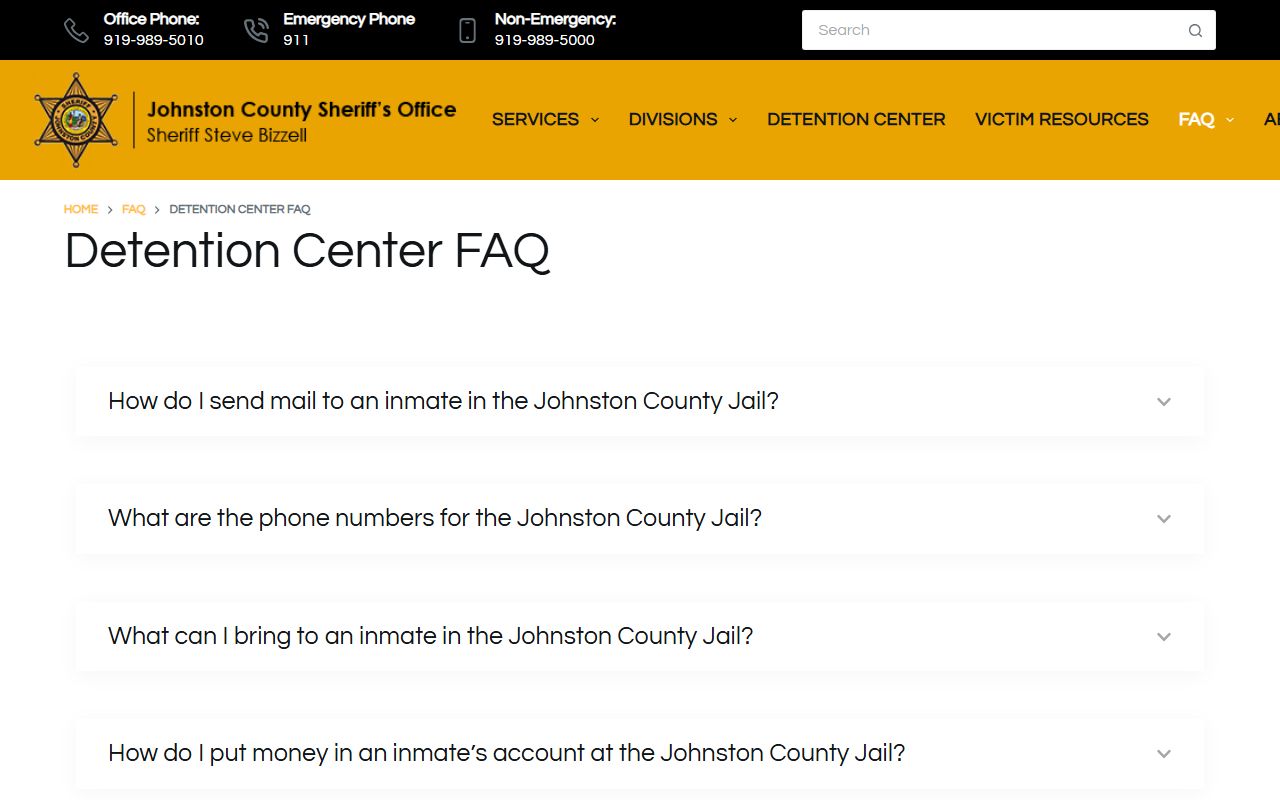
That FAQ helps after a person is in custody, but it is not a public list of outstanding Johnston County warrants.
Johnston County Warrant Channels
Use the channel that matches the question. If the concern is an active law-enforcement matter, start with the Sheriff's Office or an attorney. If the concern is a missed court date, bench order, or filed criminal case, the Clerk of Superior Court and eCourts are the right records channels. If the person is already jailed, the jail and magistrate release number become more useful than a case search.
| Channel | Use It For | Contact or Source |
|---|---|---|
| Sheriff's Office | General law-enforcement inquiry and arrest-related routing. | 2875 US-70 BUS E, Smithfield; (919) 989-5010; non-emergency (919) 989-5000. |
| Magistrates - Criminal | Criminal process, initial appearance, and release-condition questions. | (919) 209-5462; release questions (919) 209-5463. |
| Clerk of Superior Court | Filed cases, court dates, charges, orders, and bond information in court files. | 207 E Johnston St, Smithfield; (919) 209-5400. |
| Jail | Charge or bond information on a current inmate. | (919) 989-5040 with the inmate's full name. |
| eCourts Portal | Smart Search, Search Hearings, Make Payments, and judgment records. | North Carolina eCourts Portal. |
| Recent Arrest Search | Arrests in the last 15 calendar days. | JCSO recent arrest search. |
Johnston County Warrant Fallback Fields
The JCSO recent arrest search is a useful fallback when a warrant may already have led to an arrest. It is not a warrant search, and the research says the date range must stay within the last 15 calendar days. A person with an older arrest, a pending court order, or an unserved warrant may not appear there.
| Field Label | Type | Required | Options / Format Notes |
|---|---|---|---|
| First Name | Text | Optional | Use to narrow name searches. |
| Last Name | Text | Required for name search | Marked with an asterisk. |
| Beginning Date | Date | Required for date range | mm/dd/yyyy; must be within the last 15 calendar days. |
| Ending Date | Date | Required for date range | mm/dd/yyyy; must be within the last 15 calendar days. |
| Search | Button | n/a | Submits the query. |
Because no public warrant-result sample was located, the publicly visible after-arrest fields are the practical substitute: name, age, race, sex, booking date, mugshot, charge, and arrest date. The captured inmate sample did not show bond amount, court date, warrant number, magistrate, release date, attorney, or housing unit.
That limited field set should be read with care. A charge such as probation violation may be visible in the inmate profile after arrest, but the profile may not identify the warrant number, issuing judge, or full release conditions. A court user who needs the next hearing or filed order should move from the jail field list to eCourts Search Hearings and the Clerk of Superior Court. A family member who needs release instructions should move from the field list to the Magistrate's Office release line or jail FAQ.
Types of Johnston County Warrants
Different records get called warrants in casual speech, but they do not work the same way. A search warrant may be tied to an investigation and may not be public while active. A bench order or order for arrest often follows a missed court date, probation violation, contempt matter, or failure to comply with a court order. An arrest warrant is criminal process authorizing arrest based on the required showing. A fugitive or extradition hold may involve another county or state.
- Arrest warrant: Criminal process authorizing arrest on a charge or probable-cause basis.
- Bench or order for arrest: Often tied to failure to appear, probation violation, contempt, or noncompliance.
- Search warrant: Authorizes law-enforcement search and may be restricted while an investigation is active.
- Fugitive or extradition hold: Indicates an out-of-county or out-of-state process may affect custody.
- Civil or support-related order: May arise from contempt or enforcement, but not every order appears in a public warrant-style search.
Johnston County Court Warrants
Filed court activity should be checked in eCourts. Smart Search can be searched by name or case number, and Advanced Filtering Options can narrow results by location, case type, case status, and file-date range. Search Hearings can locate court dates by case number, party name, business name, attorney, judicial officer, or courtroom. Make Payments can show eligible criminal, infraction, probation, parole, cost, fee, restitution, and attorney-fee matters, but it is not a warrant clearance tool.
- Search the Portal by the person's full name and filter to Johnston County when possible.
- Open any criminal case summary and review charge, event, disposition, hearing, and financial entries.
- Use Search Hearings to confirm upcoming or missed court dates.
- Call the Clerk of Superior Court at (919) 209-5400 when online entries do not answer whether an order or bond issue exists.
- For current custody, call the jail or Magistrate's Office rather than relying only on the Portal.
The Johnston County court contact directory lists the Clerk of Superior Court, magistrates, judges, District Attorney, and related court offices.
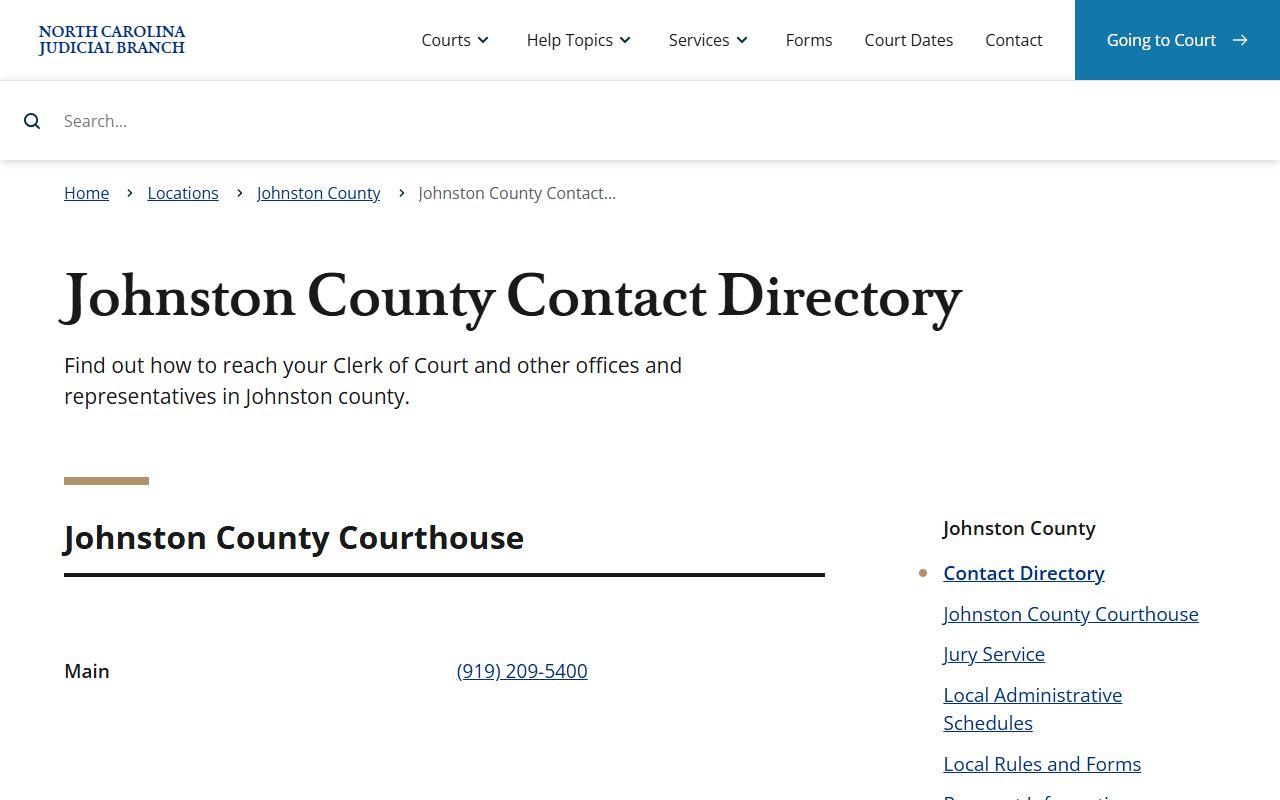
That directory is the official bridge between a warrant concern and the court offices that can confirm filed-case information.
Resolve a Johnston County Warrant
Resolving a warrant should be handled through official sources, not third-party warrant sites. The correct path depends on whether the issue is a missed court date, a new arrest, a probation violation, a bond condition, or a law-enforcement process that has not yet become a public court record. Bring identifying information, case numbers if known, and a payment method if a court or bond office has told you payment may be required.
For missed court dates, the Clerk of Superior Court is the cleanest first records contact because the clerk can tie the person's name to a case number, court date, filed order, and any available payment or bond information. For a person already in the Johnston County Jail, the jail and magistrate release number may answer the immediate custody question faster than a portal search. For a person who has not been arrested, the safest path is to call the official office or speak with counsel before appearing at a law-enforcement office or courthouse.
- Do not rely on unofficial warrant sites for clearance decisions.
- Call the Clerk of Superior Court for missed court dates, case numbers, charges, court dates, and filed orders.
- Call the Sheriff's Office or jail if the person has already been arrested or may be in custody.
- Call the Magistrate's Office release line at (919) 209-5463 for release requirements after arrest.
- Search eCourts for the case number, hearing dates, and payment eligibility.
- If told to appear, go to the courthouse, magistrate, or jail as directed by the official office or legal counsel.
- If bond is needed, the jail FAQ says a bondsman list is displayed in the Magistrate's office or may be found through a web search.
Important: A pending warrant can lead to arrest; speak with a lawyer or official court office before appearing.
Johnston County Jail After Arrest
After a warrant leads to an arrest, the jail and magistrate channels become more important than a warrant search. The inmate inquiry may show the person's name, primary charge, and arrest date if the person is still held. The jail FAQ says charge and bond questions may be directed to the Clerk's Office or jail with the inmate's full name. Release questions route to the Magistrate's Office, and bond may involve cash, conditions, or a bondsman.
The JCSO visitation page links to PayTel online scheduling for video visitation after a person is in custody.
Visitation information belongs to the post-arrest custody stage and should not be confused with checking whether a warrant is active.
Restricted Johnston County Warrants
Some warrant and process records are not public. Search warrants can be sealed or withheld while an investigation is active. Juvenile matters are restricted under North Carolina juvenile-record laws. Abuse, neglect, and dependency court files are withheld from public inspection except by court order or statute. Expunged and sealed records may not appear in ordinary public searches even if government access remains under specific legal rules.
North Carolina public-record law supports access to public records, but court access has statutory limits. G.S. 132-6 covers inspection and copies of public records, while G.S. 7A-109 addresses clerk recordkeeping and inspection except where law prohibits access. When a warrant concern involves a sealed, juvenile, mental-health, or protective-order matter, public search tools may show little or nothing.
Note: Absence from a public search result is not proof that no warrant, order, hold, or restricted process exists.