
About the Johnston County Clerk's Office
The Johnston County Clerk of Superior Court is the elected North Carolina court official responsible for court recordkeeping in the county. The official Judicial Branch contact directory lists the clerk's office through the Johnston County Courthouse main number. A high-authority local source identifies the current clerk as Michelle Creech Ball; the Judicial Branch contact page is the safer source for office contact, courthouse location, and public service links.
Under North Carolina's unified trial-court structure, Johnston County does not have a separately elected district clerk or a separate county court clerk for criminal and civil files. The Clerk of Superior Court keeps records for both the Superior Court and District Court divisions, collects money due in court cases, maintains files and indexes under Administrative Office of the Courts rules, and acts as the probate judge for estates and wills.
Johnston County Clerk of Superior Court
Clerk: Michelle Creech Ball
207 E Johnston St
Smithfield, NC 27577
(919) 209-5400
Mail: PO Box 297, Smithfield, NC 27577
Monday-Friday, 8:00 AM-5:00 PM
The official courthouse page shows the courthouse address, mailing address, weekday hours, main phone number, and Second Street wheelchair-access entrance.
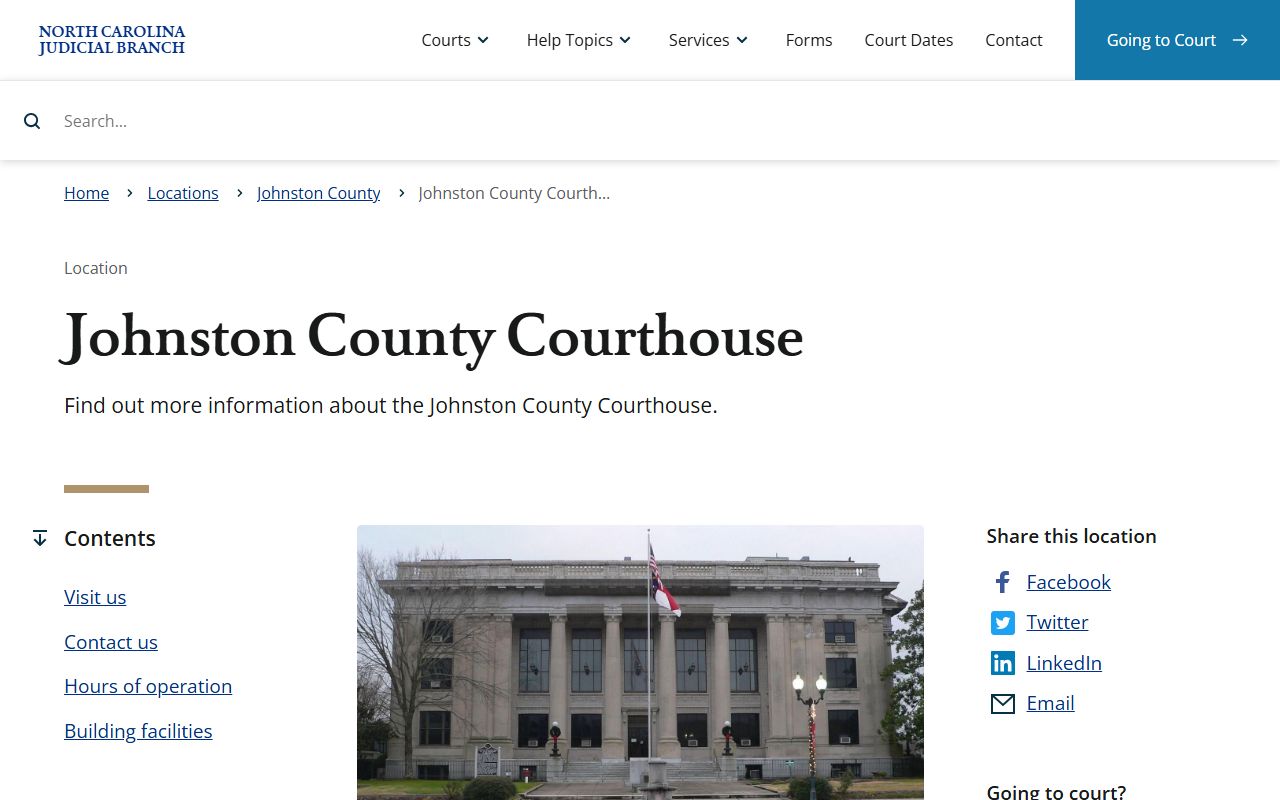
That courthouse is the practical counter for clerk records, certified copies, eligible court payments, estate filings, and older files that do not appear in Portal.
What the Clerk Does in Johnston County
The clerk's role is broader than answering records questions. North Carolina clerks perform all clerical and record-keeping functions of Superior Court and District Court. For Johnston County, that means the clerk is the records office for adult criminal cases, civil lawsuits, family and domestic case filings, special proceedings, judgments, estate administration, and many court financial entries.
- Maintains court files, dockets, indexes, and case records for Superior Court and District Court matters.
- Collects court costs, fines, restitution, eligible traffic-citation payments, and other money due in court cases.
- Issues or processes court documents, certified copies, judgments, estate papers, and other official records when allowed by law.
- Acts as ex officio Judge of Probate for wills, estates, small estate procedures, inventories, accountings, and routine estate hearings.
The Judicial Branch Johnston County page identifies Johnston County as Prosecutorial District 13, Superior Court District 13, and District Court District 12, and links the local courthouse, contacts, calendars, payment information, local rules, and public services.
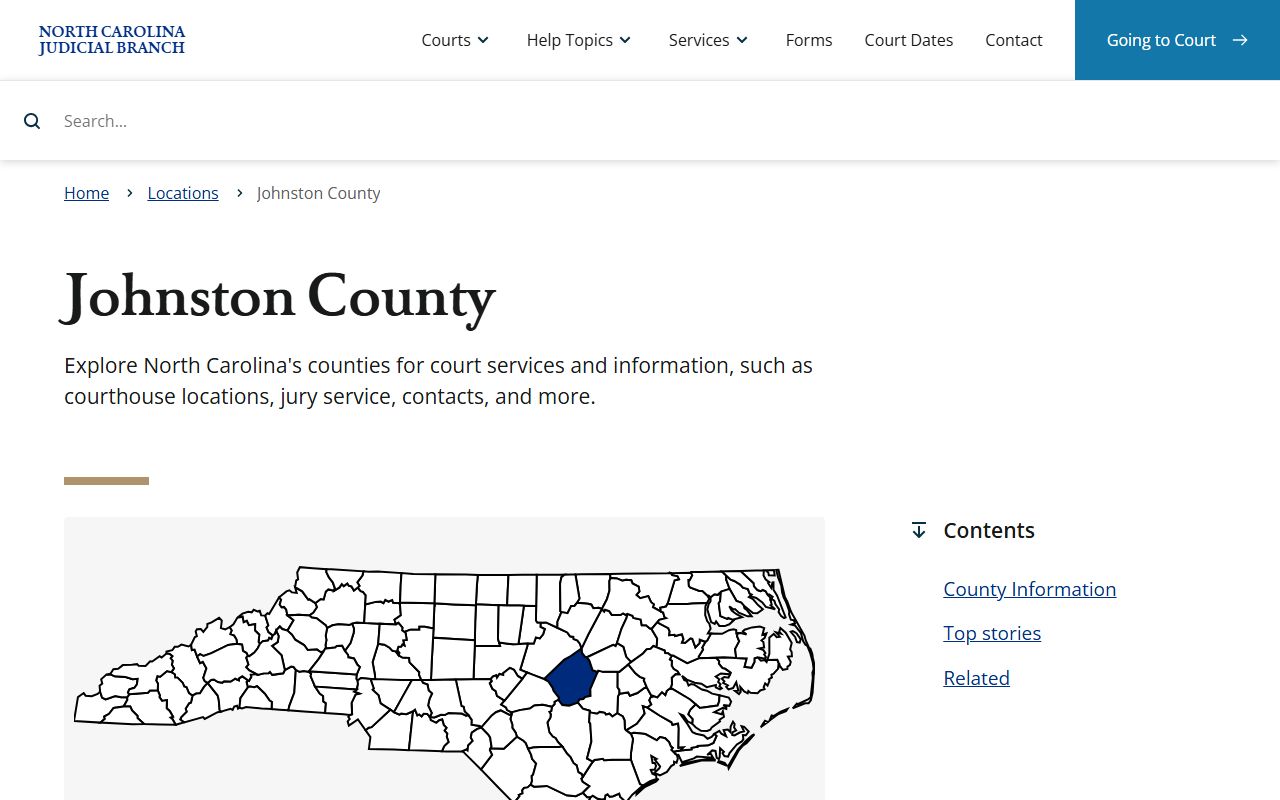
Those local Judicial Branch links are useful when a clerk question depends on the case type: a payment question may start with the payment page, a hearing question with Search Hearings, and a local procedure question with the Johnston County rules and forms page.
Clerk Record Request Channels
Most Johnston County court-record searches should start online, but Portal access is not the same thing as a certified copy or complete file inspection. Use the access channel that matches the record problem:
| Channel | Best Use | Johnston County Detail |
|---|---|---|
| eCourts Portal Smart Search | Public case summaries, party searches, case numbers, events, dispositions, and financial information when available | Search by record number or party name, then filter by Johnston County, case type, status, or file date. |
| Portal Search Hearings | Court dates, hearing type, courtroom, judicial officer, attorney, party, or case-number calendar searches | Choose Johnston County as the location when narrowing statewide hearing results. |
| Portal Make Payments | Eligible criminal, infraction, probation, parole, restitution, and attorney-fee payments | Not available for every matter; cash bonds, civil judgments, child support, and some other items are excluded. |
| Clerk counter | Certified copies, older records, case-specific questions, and documents not visible online | Visit the Johnston County Courthouse during public hours or call (919) 209-5400 first. |
| Eligible payments or copy requests when the office can process by mail | Use Clerk of Superior Court, Johnston County Courthouse, PO Box 297, Smithfield, NC 27577. | |
| Judicial Branch public-record request | Existing Judicial Branch records outside ordinary case-file access | Agencies are not required to create or compile a record that does not already exist. |
| Remote Public Access Program | Licensed statewide criminal/civil court data access or extracts | NCAOC program for approved users needing broader data access than ordinary public Portal searches. |
How to Request a Certified Copy
A certified copy is an official court copy with the clerk's certification. People commonly need certified copies for judgments, divorce decrees, estate authority, name-change or identity issues, appeals, licensing, agency filings, and legal proof of a court disposition. Portal information can help identify the case, but the official certified document must come from the clerk.
- Identify the case number if possible. Search the eCourts Portal by case number, party name, citation number, or business name and filter to Johnston County.
- Confirm the exact document needed. Examples include judgment, order, divorce decree, disposition, estate letter, accounting, or other filed document.
- Call the Clerk of Superior Court at (919) 209-5400 if the file is old, not visible in Portal, restricted, sealed, or unclear.
- Submit the request in person or through an available mail process with party names, case number, document title, number of copies, mailing address, and payment method.
- Use lawful payment methods. For Johnston County mail court payments, the local page says money order or certified check only, payable to Johnston County Clerk of Superior Court; do not mail cash or personal checks.
- Allow clerk staff to verify access. Juvenile, sealed, expunged, adoption, mental-health, abuse/neglect/dependency, and protected personal information may be unavailable or redacted.
- Pick up the certified copy or wait for mailing, depending on the method the clerk confirms for the request.
The Judicial Branch public-record request page explains the difference between court records, vital records, police reports, prison records, and other public-record request paths.
Use that statewide public-record request path for existing Judicial Branch records that are not simply ordinary case-file copies from the clerk counter.
Records Request and Portal Field Inventory
The research did not locate a Johnston-only clerk copy-request form with a fixed field list. A useful request should still give clerk staff enough information to find the file, confirm public access, calculate any charge, and return the correct document. Portal and Judicial Branch public-record forms also use structured identifiers such as case number, party name, location, date range, and request description.
| Field | Required | Notes |
|---|---|---|
| Case Number | Strongly recommended | North Carolina Enterprise Justice case numbers use year, case-type letters, six-digit sequence, and three-digit county identifier, such as the official example 21CR000003-910. |
| Party Names | Yes if no case number | Use last, first middle suffix format when possible; Portal supports party, nickname, business-name, and sounds-like searching. |
| Johnston County Location | Yes for Portal filters | Portal is statewide, so location filtering prevents results from other North Carolina counties. |
| Document Type | Yes | Name the judgment, order, decree, disposition, estate paper, or other filing requested. |
| Date Range or File Date | Recommended | Useful for common names, older files, and searches by filing period. |
| Certified or Plain Copy | Yes | Say whether certification is needed; Portal printouts are not certified court copies. |
| Return Method | Yes | Provide pickup or mailing instructions and a reliable phone number for follow-up. |
Johnston County Clerk Payments and Related Fees
The research captured Johnston County's payment rules and Register of Deeds copy fees, but not a complete current statewide clerk copy-fee chart. Do not assume a court-copy charge until the clerk confirms it or the current North Carolina court costs chart is checked. Payment eligibility also depends on case type and status.
| Item | Fee / Rule | Source Notes |
|---|---|---|
| Mail court payment | Money order or certified check only; no cash and no personal checks | Make payable to Johnston County Clerk of Superior Court and include the citation number when paying an eligible citation. |
| In-person court payment | Cash, credit/debit plus processing fees, money order, or certified check; no personal checks | Pay at the Cashier's Office in the Johnston County Courthouse for eligible matters. |
| Online court payment | Credit/debit plus processing fees for eligible matters | Portal accepts eligible criminal/infraction/probation/parole payments; local page notes common card acceptance. |
| Certified court copies | Confirm with Clerk of Superior Court | Exact Johnston clerk copy charges were not isolated in captured official sources. |
| Register certified copies of recorded documents | $5 first page + $2 each additional page | Register of Deeds fee page; applies to recorded Register documents, not court case files. |
| Register uncertified copies | $0.10 per page; minimum $1 mail processing fee | Register of Deeds fee page. |
| Marriage license | $60 issuance fee | Register of Deeds, not Clerk of Superior Court. |
| Vital certified copy | $10 | Register of Deeds birth/death/vital-record context. |
Portal, Elevated Access, and Common Forms
Public Portal search does not require registration for ordinary public case information. Registration mainly helps frequent users save cases to "My Cases"; it does not unlock restricted records. Elevated access is a separate process for attorneys and other verified users who have legal authority and active case assignment to see restricted case information.
- NC eCourts Portal - Smart Search, Search Hearings, Make Payments, and NC Judgment Search.
- Portal Training and Resources - public search guidance, case summaries, payments, browser needs, case-number format, and elevated-access explanation.
- AOC-A-264 Portal Elevated Access Request/Agreement - attorney/elevated access form used through File & Serve.
- Johnston County Local Rules and Forms - local domestic, civil, criminal, juvenile, pretrial release, and related forms.
The AOC-A-264 form page identifies the elevated-access request as an Administrative/Accounting form, last modified May 6, 2026, for counsel seeking Portal access beyond ordinary public viewing.
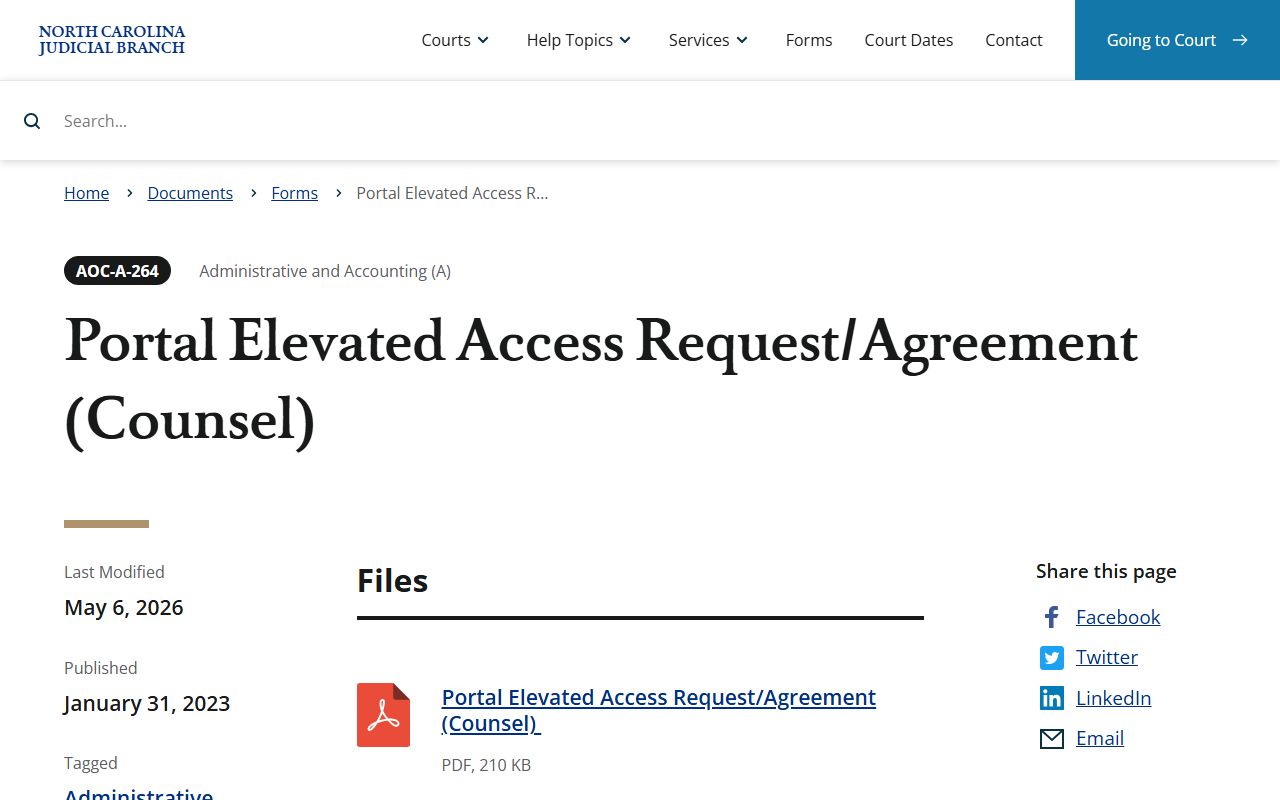
Elevated access should not be described as a general public workaround; it is role-based access for users who can verify legal authority to view information that anonymous users cannot see.
Mail, Online Services, and the Register of Deeds Distinction
Johnston County court filings and records live in the North Carolina court system, not in a county-only clerk database. For online records, use eCourts Portal. For official copies, older files, probate filings, court payments, and case-specific record questions, use the Clerk of Superior Court. Mail for the courthouse goes to Johnston County Courthouse, PO Box 297, Smithfield, NC 27577.
Do not send marriage-license, birth-certificate, death-certificate, deed, UCC, passport, or recorded-document copy requests to the clerk unless the clerk has specifically told you to do so. Those records are handled by the Johnston County Register of Deeds, 207 E Johnston Street, Suite 209, Smithfield, NC 27577. The Register of Deeds lists Craig Olive as Register, main phone (919) 989-5160, vital records phone (919) 989-5161, fax (919) 989-5728, and email rodinfo@johnstonnc.gov.
The Register of Deeds FAQ specifically says estate, will, and divorce decree information is not in the Register's office and is instead with the Clerk of Superior Court at (919) 209-5400. That distinction is the key local routing rule: divorce decree, estate, will, court judgment, criminal case, traffic case, and civil lawsuit records go through the clerk; marriage licenses, recorded marriage certificates, vital records, deeds, and many recorded land documents go through the Register of Deeds.