
What Johnston County Probate Covers
North Carolina probate is not handled by a separate county probate court. The elected Clerk of Superior Court and assistant clerks hold most estate hearings and preside over most estate cases. In Johnston County, that makes the Clerk of Superior Court the probate contact for estate administration, will probate, small-estate collection processes, inventories, accountings, creditor notices, allowances, guardianship estate issues, and related special proceedings.
The Judicial Branch court-officials page describes clerks as record keepers and probate officers.
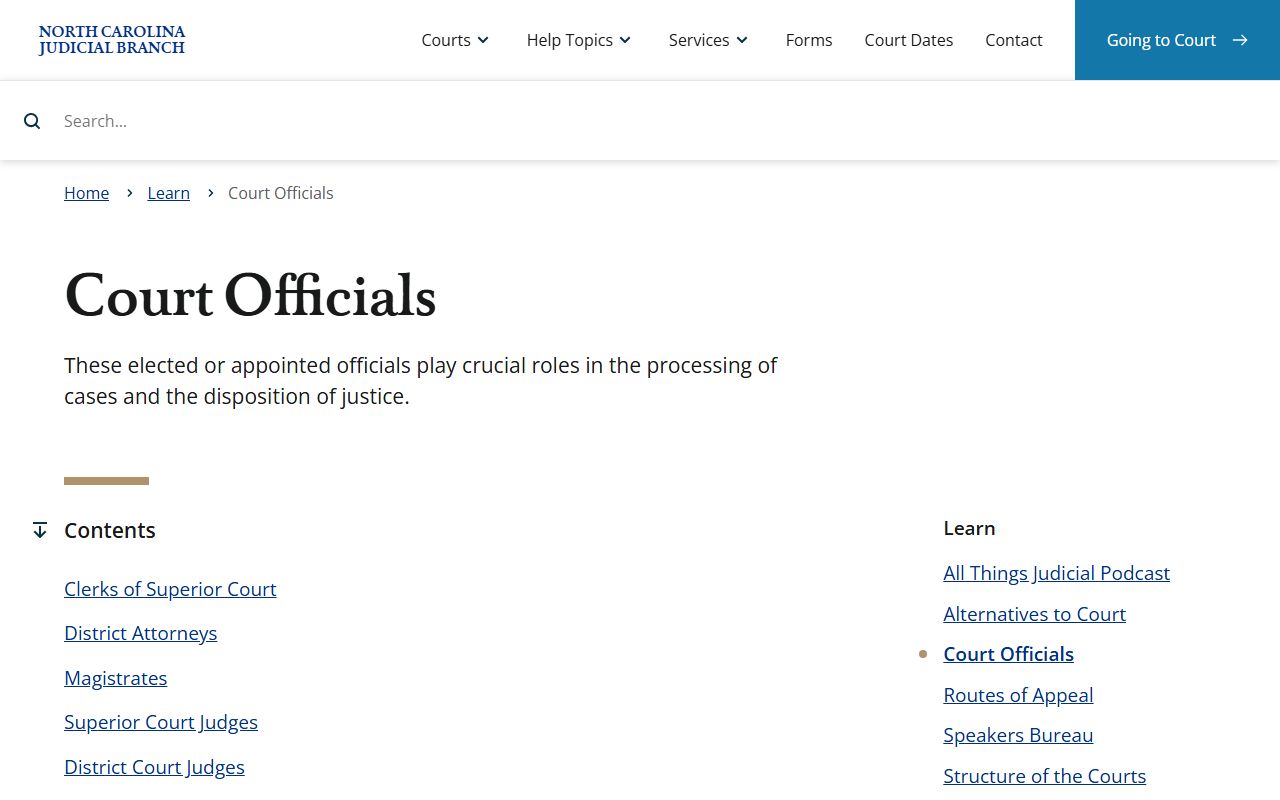
That statewide official source supports the local term used here: Clerk of Superior Court acting as ex officio Judge of Probate.
If someone challenges the validity of a will through a caveat proceeding, the caveat goes before a Superior Court judge. Routine estate administration, however, starts with the clerk. Divorce decrees and criminal cases are separate court records, while marriage licenses and recorded marriage certificates are with the Register of Deeds. Estate files and wills are not Register of Deeds records.
Johnston County Probate Terms
Probate records use terms that are easy to confuse. A will, an estate file, and a guardianship file may all be handled by the clerk, but they do not mean the same thing. The definitions below explain the terms most likely to appear in a Johnston County probate record or estate form.
- Testator
- A person who made a will.
- Executor
- The person named in a will to carry out estate duties after appointment.
- Intestate
- Dying without a valid will, so the estate follows North Carolina intestacy rules.
- Guardian
- A person appointed to act for a minor or an incompetent adult in a permitted role.
- Conservatorship
- A term often used in other states for property management; North Carolina sources more often use guardianship and estate administration terms.
- Caveat
- A challenge to a will's validity that is heard by a Superior Court judge.
Search Johnston County Probate Records
Probate records can be searched through eCourts Portal Smart Search when public case information is available. Use a case number or name, then filter by Johnston County. The Portal's Search Hearings tool also includes a "Probate or Mental Health" hearing-type option. Because estate files may include paper documents, older filings, certified-copy requests, and restricted guardianship or mental-health material, the Clerk of Superior Court remains the main fallback when the online search does not answer the question.
The Judicial Branch estates page explains estate administration and the clerk's probate role.
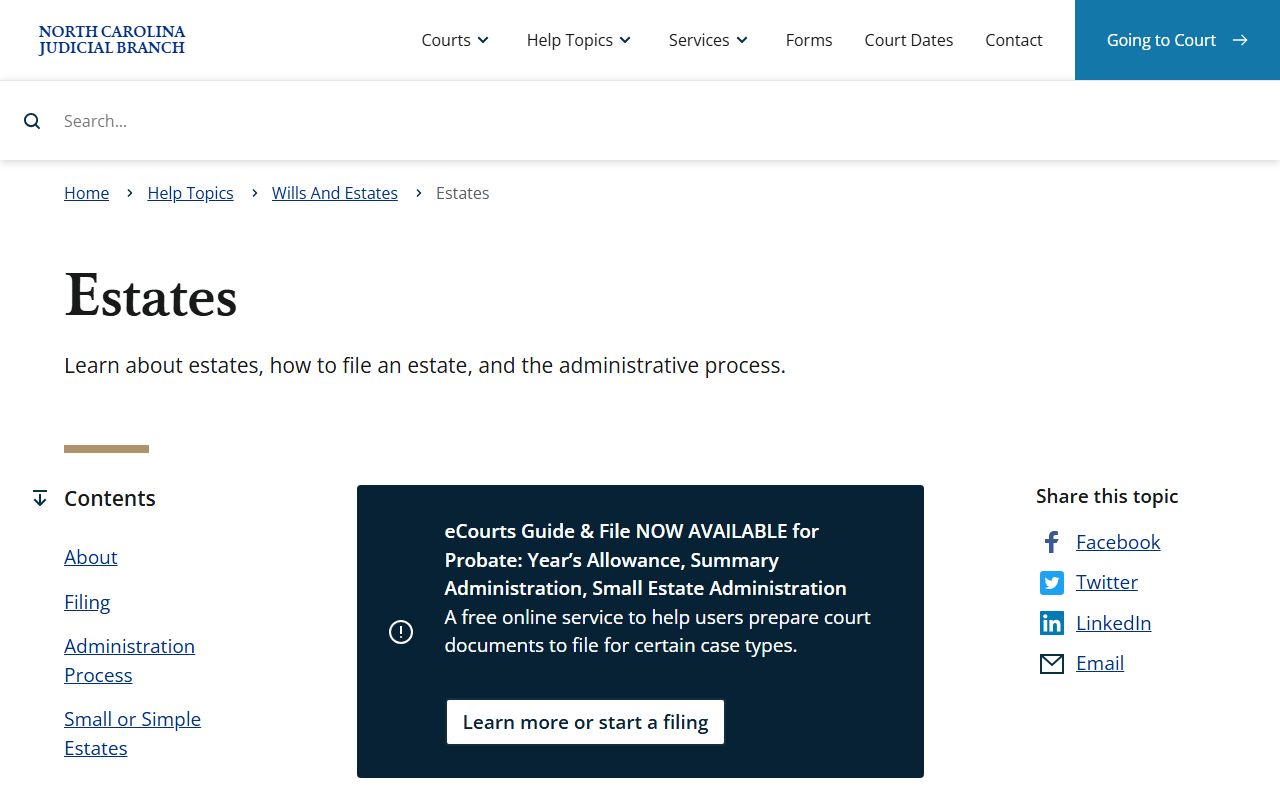
The estates page is the statewide procedural source behind Johnston County estate searches, especially for the clerk's role in routine estate hearings.
| Field label | Type | Required | Options or format notes |
|---|---|---|---|
| Smart Search record or name | Text | Yes | Use a case number or name; wildcard rules may help with partial names. |
| Location | Dropdown | Optional | Choose Johnston County to avoid statewide matches. |
| Case Type | Dropdown | Optional | Filter for estate, probate, or special proceeding where available. |
| Case Status | Dropdown | Optional | Status choices were not fully exposed in captured text. |
| File Date Start and End | Date | Optional | Use a date range when the estate filing period is known. |
| Search Hearings hearing type | Dropdown | Required if using hearings | Select Probate or Mental Health where appropriate. |
- Search eCourts Portal Smart Search by decedent name, party name, or case number.
- Filter the search to Johnston County and narrow by case type, status, or file-date range.
- Use Search Hearings if the question is about a probate hearing date or hearing type.
- Contact the Clerk of Superior Court when a document, certified copy, old file, or restricted record question is not resolved online.
Johnston County Probate Contact
There is one local probate contact point identified in the research: the Johnston County Clerk of Superior Court at the courthouse in Smithfield. The office is the practical hub for estate filings, probate hearings before the clerk or assistant clerk, certified copy questions, and record access that goes beyond the public Portal screen.
Clerk of Superior Court acting as ex officio Judge of Probate
Johnston County Courthouse
207 E Johnston St
Smithfield, NC 27577
(919) 209-5400
Monday-Friday, 8:00 AM-5:00 PM
The courthouse page also notes wheelchair access through the side entrance off Second Street, with the ramp in the middle of the block. That detail matters for estate filings because original wills, death certificates, and signed estate documents may need to be delivered or reviewed at the courthouse counter.
Johnston County Estate Process
Estate administration starts with deciding whether Johnston County is the proper county and whether the decedent left a will. The clerk or assistant clerk reviews the filing, and a personal representative or collector may receive authority to act. Later steps can include creditor notice, inventory, accounting, distribution, and final accounting. Contested will validity is treated differently because a caveat goes before Superior Court.
The decedents' estate procedures pamphlet is the official procedural pamphlet for estate administration.
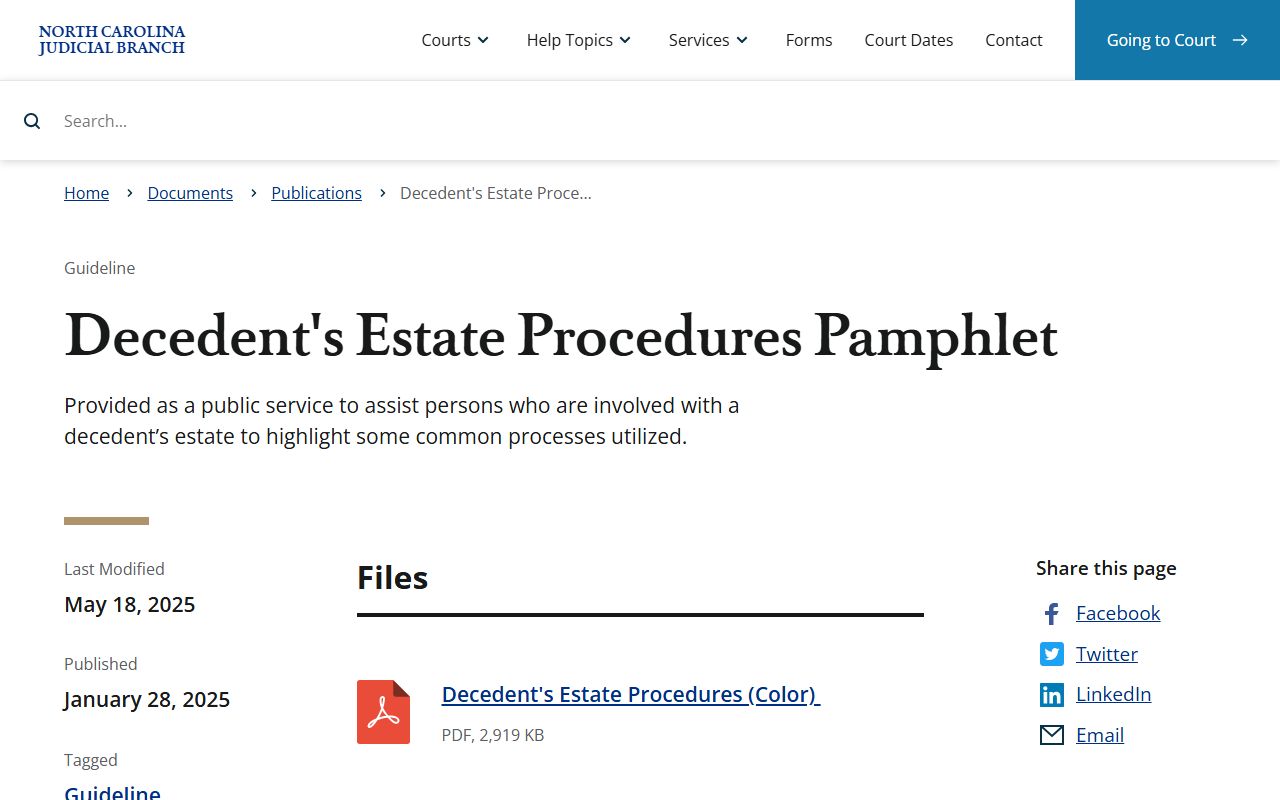
The pamphlet supports the practical estate sequence used by the clerk, from opening an estate through inventory and closing steps.
- Confirm the decedent's county connection and locate the original will, if one exists.
- Contact or visit the Clerk of Superior Court estate or probate counter.
- Bring death certificate, original will, applicant identification, heir or family information, and asset and debt information.
- File the estate application, small-estate process, or other required form.
- Have the clerk or assistant clerk review filings and issue authority if requirements are met.
- Complete notices, creditor steps, inventory, accountings, distributions, and final filings as required.
Johnston County Probate Forms
Estate forms are statewide Judicial Branch forms rather than Johnston-only forms. The research identified the estate forms index, including affidavits for probate of a will or codicil, affidavits when witnesses are unavailable, affidavits for a holographic will, and certificate of probate forms. The correct form depends on the estate type, whether there is a will, and what the clerk requires for the filing.
The N.C. Judicial Branch estate forms index lists estate and will probate forms.
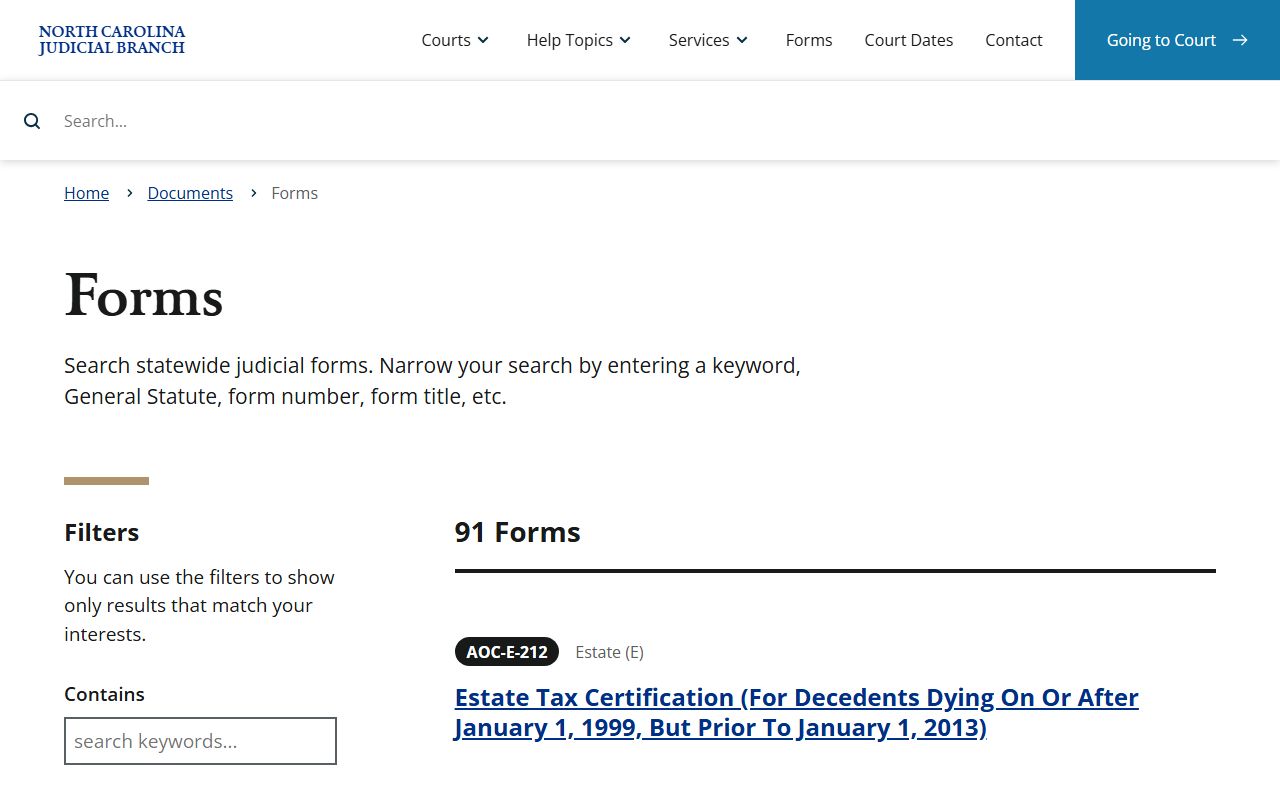
The forms index is useful because it points to official estate forms instead of unofficial templates for wills, affidavits, and probate certificates.
| Record or form type | What it may show |
|---|---|
| Application or petition | Who is asking to open or administer the estate and the basic case details. |
| Will or codicil filing | The instrument offered for probate and supporting proof. |
| Inventory | Estate assets reported by the representative. |
| Accounting | Money received, expenses paid, distributions, and status of estate administration. |
| Creditor notice | Notice steps tied to claims against the estate. |
| Order or certificate | Clerk action, authority to act, or probate determination. |
Johnston County Probate Fees
Exact Johnston County probate fees were not located in the captured official research. The research notes that the official court-costs page links current cost charts, but a Johnston-specific probate fee table was not fully harvested. For that reason, no probate filing fee, letters fee, guardianship fee, or certified-copy amount is stated as a fixed number here.
| Item | Fee status |
|---|---|
| Original probate or estate filing | Exact fee not located in captured official sources; verify with the Clerk of Superior Court or current N.C. court costs chart. |
| Letters testamentary or authority documents | Exact fee not located in captured official sources. |
| Certified probate copy | Exact probate copy fee not isolated in captured official sources. |
| Guardianship or related special proceeding | Exact fee not located in captured official sources. |
Fee note: Use the Clerk of Superior Court or current North Carolina court-cost chart before filing, because captured research did not locate exact probate fees.
Restricted Johnston County Probate Records
Not every probate-adjacent record is fully public. Guardianship, incompetency, mental-health, minor-related, sealed, and redacted filings may be restricted. Portal Search Hearings includes "Probate or Mental Health" as a hearing type, but mental-health material often contains restricted personal and medical information. Public search may show limited case information or no visible record at all.
For routine estate files, G.S. 7A-109 supports public access to clerk records unless a law blocks access. G.S. 132-6.2 addresses copy format and fees for public records. These laws do not override restrictions on guardianship, mental-health, juvenile, sealed, or otherwise confidential filings.
Register of Deeds access is not the right fallback for estates. The Register handles marriage licenses, recorded marriage certificates, vital records, and deeds. For probate records, estate files, or wills, use the Clerk of Superior Court. Marriage and divorce records have their own office split, which is covered in Johnston County marriage and divorce records.