
Johnston County Criminal Court Records
A criminal court record is the case-level file kept by the Clerk of Superior Court after charges are filed and a court case opens. It is broader than the charge line that may appear in the jail system. It may include the initial charge, later amended charges, arraignment or first appearance events, bond or release-related entries, indictments or informations, motions, hearings, pleas, trial results, disposition, sentence, costs, restitution, probation conditions, and appeal entries.
Criminal cases in Johnston County are split by court division. District Court handles misdemeanors and infractions, including many traffic-related criminal matters. Superior Court handles felony criminal cases and misdemeanor or infraction appeals from District Court. Magistrates are District Court judicial officers and may be involved at the start of a criminal matter through initial appearances, criminal process, release conditions, and warrants. For the narrower arrest-to-charge path, the charge-focused record is addressed through Johnston County arrest records and court charges.
The Judicial Branch criminal law help topic gives statewide context for criminal cases and related court processes.
That statewide criminal-law page supports the local distinction between a custody record, a charging record, and the full criminal court case file.
Search Johnston County Criminal Cases
The main online access point for Johnston County criminal court records is the North Carolina eCourts Portal. Use Smart Search for the case summary and register of actions. Use Search Hearings for court dates, courtroom, judicial officer, and hearing type. Use Make Payments only when the criminal or infraction matter is eligible for online payment. The Portal training page states that anonymous public users can search publicly available court information, while registration only helps save cases and does not grant access to restricted case types.
- Open the eCourts Portal and choose Smart Search for the criminal court case record.
- Search by defendant name or case number in the Portal's required format.
- Use Advanced Filtering Options and select Johnston County as the location.
- Narrow by case type, case status, file date, or party search criteria when results are broad.
- Open the case summary to review charges, events, hearings, dispositions, and financial entries when public.
- Use Search Hearings for the next court date if the case summary does not make scheduling clear.
- Request a certified copy from the Clerk of Superior Court when an official criminal court record is needed.
Charge and bond information may also be checked by calling the Clerk of Superior Court at (919) 209-5400 or the jail at (919) 989-5040 with the inmate's full name, according to the jail-related research. That phone path is not a substitute for a certified criminal court record, but it can help when a new arrest has not yet produced a clear online case trail.
Johnston County Criminal Case Flow
A criminal court record changes as the case moves through the court. The first public sign may be a charge after arrest or citation. Later entries may show hearings, motions, plea negotiations, trial settings, disposition, and sentence. Felony cases can move from District Court activity into Superior Court through indictment or other felony prosecution steps. Misdemeanors usually remain in District Court unless appealed or otherwise moved under North Carolina procedure.
Case flow: Charges Filed › Arraignment › Pretrial and Motions › Plea or Trial › Disposition › Sentencing
| Stage | What Happens |
|---|---|
| Charges Filed | The accusation enters the court system through warrant, citation, magistrate process, indictment, information, or other charging paper. |
| Arraignment | The charge is addressed in court and plea or status issues may be set. |
| Pretrial and Motions | Attorneys may file requests, discovery issues may arise, and the court may schedule hearings or continuances. |
| Plea or Trial | The case may resolve by plea, dismissal, reduction, or trial. |
| Disposition | The record shows the outcome of a charge, motion, or case, such as guilty, dismissed, or not guilty. |
| Sentencing | The court records punishment, costs, restitution, probation, jail or prison terms, or other conditions when there is a conviction. |
What Johnston County Criminal Records Show
Portal case summaries and Clerk of Superior Court files may show different levels of detail depending on public access rules. The official Portal guide says the case summary can include the timeline, case information, assignment information, party information, case events, dispositions, hearings, and financial information when applicable. In criminal cases, those fields help distinguish the accusation, the court process, the final outcome, and the sentence.
| Field | What It Shows |
|---|---|
| Case Number | The Enterprise Justice identifier, generally using year, case letters, sequence number, and county code. |
| Defendant | The person charged in the criminal case, with public identity details limited by access rules. |
| Charge | The alleged offense or offenses filed in the case, including later amended or reduced charges when recorded. |
| Court Division | District Court for misdemeanors, infractions, and many traffic matters, or Superior Court for felony cases and appeals. |
| Hearings | Dates, hearing types, courtrooms, and judicial officers when exposed through Search Hearings or the case summary. |
| Motions | Requests made to the court, such as continuance, suppression, bond, discovery, or other case actions when public. |
| Plea | The defendant's formal answer or resolution position, such as guilty, not guilty, or another court-recorded plea entry. |
| Disposition | The outcome of each charge or the case, including dismissed, guilty, not guilty, or other resolution language. |
| Sentence | Jail, prison, probation, costs, restitution, or other court-ordered conditions after conviction. |
| Financial Information | Costs, fees, restitution, attorney fees, or probation/parole items when applicable and payment-eligible. |
Charges vs Convictions
Johnston County criminal court records can contain charges that did not become convictions. A charge is an accusation in a court case. A conviction is a finding of guilt or a guilty plea that the court accepts. A record may show dismissed charges, reduced charges, amended charges, not-guilty results, or pleas to a different count. Reading only the charge line can lead to the wrong conclusion, especially when the disposition is separate from the initial allegation.
| Topic | Charge | Conviction |
|---|---|---|
| Meaning | An accusation filed into the criminal court process. | A court result based on a guilty plea or finding of guilt. |
| Timing | Appears near the start of the case or after amendment. | Appears after plea, trial, or other final criminal resolution. |
| Record risk | May be dismissed, dropped, reduced, or changed. | May carry sentence, costs, restitution, probation, or collateral effects. |
| Where to verify | Check charge entries and court events. | Check disposition and sentencing entries. |
Johnston County Criminal Prosecution
The District Attorney for Prosecutorial District 13 is Jason Waller. The district includes Johnston County, and the District Attorney's office represents the State of North Carolina in criminal prosecutions. The Johnston County contact directory lists the District Attorney phone as (919) 209-5520, while local government information places the office at 125 S. Second Street, Smithfield, NC 27577, with mailing address PO Box 1029, Smithfield, NC 27577.
Prosecutor action matters because charges may be reduced, dismissed, amended, indicted, tried, or resolved by plea. A criminal court record can show both the original charge and later court action. The District Attorney does not keep the court case file; the Clerk of Superior Court does. Prosecutor decisions, however, often explain why a record's charge field and disposition field do not match at first glance.
The Judicial Branch news item naming Jason T. Waller as District Attorney is one source for the current prosecution leadership tied to Johnston County criminal court records.
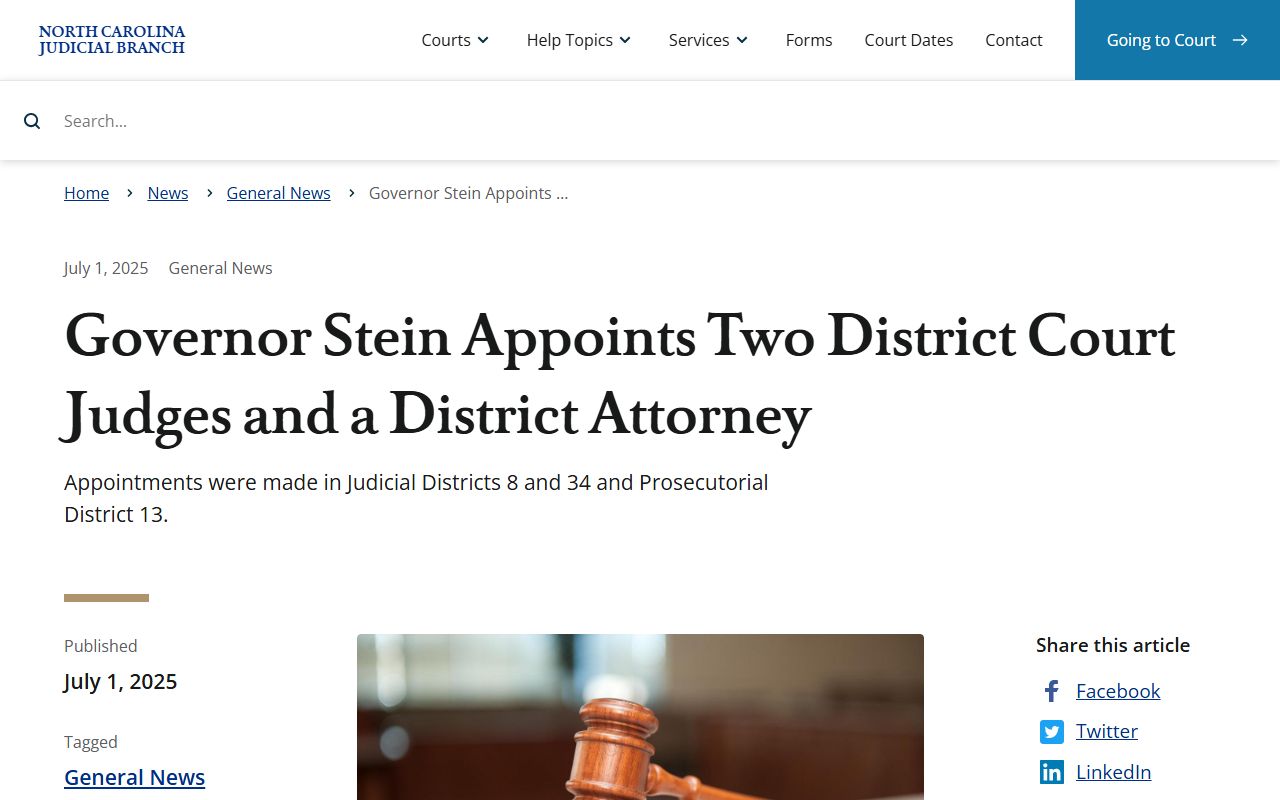
That appointment context is relevant because current Johnston County criminal cases run through Prosecutorial District 13.
Sealed vs Expunged Criminal Records
Restricted criminal records require careful reading. A sealed record may still exist, but public access is limited by court order or statute. An expunged record is removed from ordinary public criminal-record access if a court grants relief under the proper North Carolina expunction law. Neither status should be assumed from a missing Portal result. The case may be restricted, too old for easy lookup, filed under a variant name, or outside the public view for another reason.
| Topic | Sealed | Expunged |
|---|---|---|
| Public visibility | Hidden or limited from ordinary public inspection. | Removed from ordinary public criminal-record access after court order. |
| Record existence | May still exist for court, law-enforcement, or statutory purposes. | Government access may remain under statutory exceptions. |
| How it happens | By statute, rule, or court order limiting access. | By filing the correct petition in the county where the charge or conviction occurred. |
| Johnston County path | Ask the Clerk of Superior Court about access authority or court order requirements. | Identify the case, select the correct AOC petition, and file through the Clerk of Superior Court. |
G.S. 15A-145 addresses certain first-offender misdemeanors and underage alcohol offenses. G.S. 15A-145.5 addresses certain nonviolent misdemeanor and felony convictions with exclusions and waiting periods. The research did not locate a Johnston-specific expunction fee table, so exact filing-cost statements should come from current court-cost charts or the clerk.
The official G.S. 15A-145 statute page is one of the captured expunction sources.
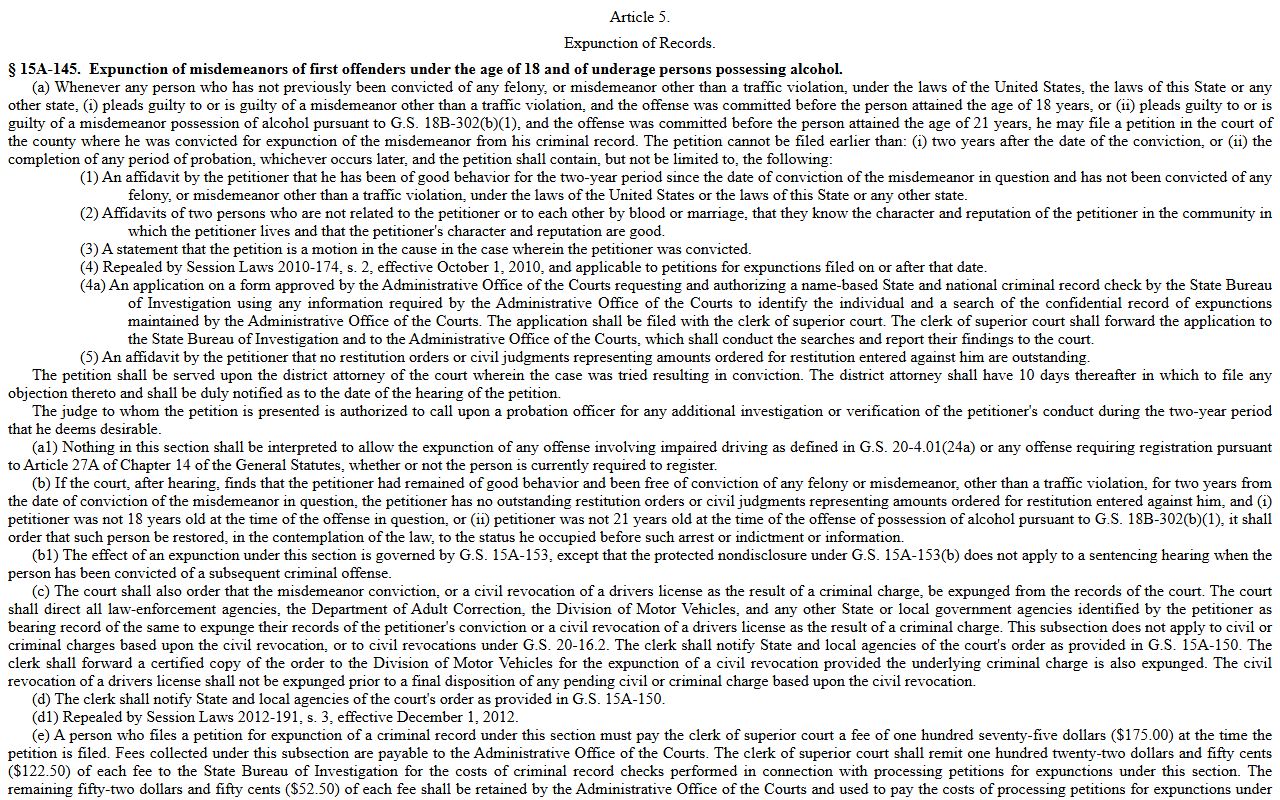
The statute source supports the page's expunction distinction without treating every sealed or missing record as expunged.
Restricted Johnston County Criminal Records
Juvenile records are not handled like adult criminal court records. G.S. 7B-3000 defines juvenile court records, while G.S. 7B-2901 protects abuse, neglect, and dependency records from public inspection except by court order or statutory access. Criminal records may also redact Social Security numbers, protected addresses, financial-account details, minor names, and other sensitive identifiers.
Some criminal-adjacent information lives outside the court file. The Sheriff's Office inmate inquiry is a current-custody tool, and the recent arrest search is limited to arrests from the last 15 calendar days. The North Carolina Department of Adult Correction offender search covers state prison offenders, probationers, parolees, and historical correction information, not the full Johnston County court file. For complete case outcomes, use Portal and the Clerk of Superior Court.
Note: A missing online result does not prove that no criminal court record exists.
Johnston County Criminal Docket Updates
Recent local initiatives can affect how criminal cases move through court. A September 25, 2024 Judicial Branch news item says a Governor's Highway Safety Program grant would expedite Driving While Impaired cases in Johnston, Mecklenburg, and Wake counties. That source does not describe a separate Johnston County DWI treatment court, but it does show that DWI scheduling and docket management were active priorities in Johnston County.
Johnston County also has a Public Defender Office within North Carolina Indigent Defense Services. IDS lists Johnston Defender District 13, Regional Defender Tucker Charns, Public Defender A. Traynham Dorn, and Public Defender Office phone (919) 209-5570. The office began taking cases October 14, 2024. Defense representation can appear in criminal court records through attorney entries, motions, hearings, and case events.
The Prosecutorial District 13 page identifies the District Attorney office tied to Johnston County criminal court records.
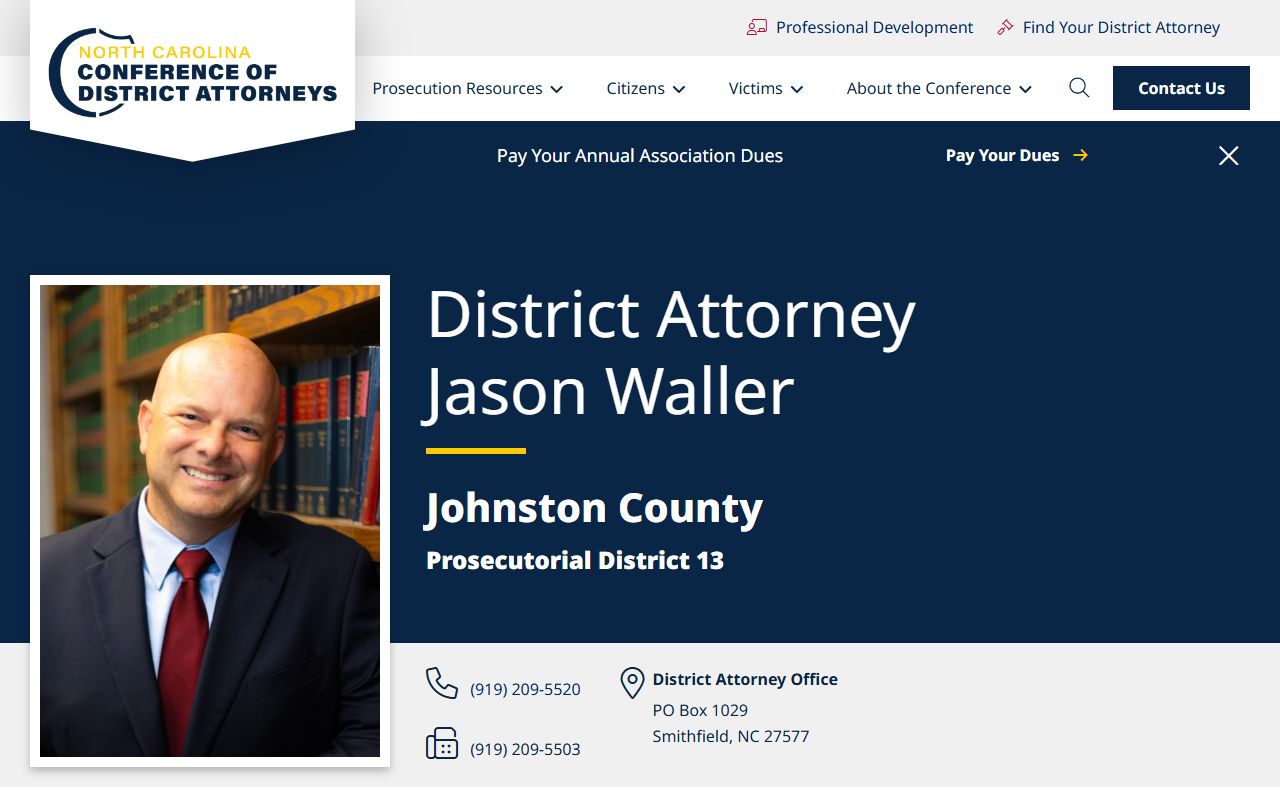
The district page helps connect criminal case records to the state prosecution office that handles Johnston County charges.